leetcode树

a搜索二叉树:左子树小于根节点,右子树大于根节点。

平衡树:左右子树高度差不大于1

一般解决二叉树的问题采用递归以及递归转非递归的方法。

98.验证二叉搜索树?

  • 节点的左子树只包含小于当前节点的数。
  • 节点的右子树只包含大于当前节点的数。
  • 所有左子树和右子树自身必须也是二叉搜索树。
1
2
3
4
5
6
7
8
9
10
11
12
13
14
15
16
/*
左子树的所有点应该在(minVal,root),右子树在(root,maxVal)
*/
public boolean isValidBST(TreeNode root) {
return helper(root,Long.MIN_VALUE,Long.MAX_VALUE);
}

public boolean helper(TreeNode root,long minVal,long maxVal){
if(root==null){
return true;
}
if(root.val<=minVal||root.val>=maxVal){
return false;
}
return helper(root.left,minVal,root.val)&&helper(root.right,root.val,maxVal);
}

还有一种做法:中序遍历结果是递增的,即为二叉搜索树

1
2
3
4
5
6
7
8
9
10
11
12
13
14
15
16
17
18
19
20
21
22
23
24
25
26
27
28
public boolean isValidBST(TreeNode root) {
boolean isRoot = true;
if(root==null){
return true;
}
Stack<TreeNode> stack = new Stack<>();
int last = Integer.MIN_VALUE;
while(!stack.isEmpty()||root!=null){
while(root!=null){
stack.push(root);
root = root.left;
}
if(!stack.isEmpty()){
TreeNode node = stack.pop();
if(isRoot){
last = node.val;
isRoot = false;
}else if(node.val>last){
last = node.val;
}else{
return false;
}
//dayin
root = node.right;
}
}
return true;
}

144.前序非递归遍历

1
2
3
4
5
6
7
8
9
10
11
12
13
14
15
16
public List<Integer> preorderTraversal(TreeNode root) {
List<Integer> result = new ArrayList<>();
Stack<TreeNode> stack = new Stack<>();
while(!stack.isEmpty()||root!=null){
while(root!=null){
stack.push(root);
result.add(root.val);
root = root.left;
}
if(!stack.isEmpty()) {
TreeNode node = stack.pop();
root = node.right;
}
}
return result;
}

94.中序非递归遍历

1.将整棵树的左子树压入栈中

2.每次取出栈顶元素,如果他有右子树,则将右子树压入栈中。

1
2
3
4
5
6
7
8
9
10
11
12
13
14
15
16
17
18
19
20
/**
* 将root的最左的元素全部压入栈,当root==null,表示压到底了,最左侧已经没有元素了,此时,可以将栈顶元素取出
* 并开始对右子树做同样操作
* */
public List<Integer> inorderTraversal(TreeNode root) {
List<Integer> result = new ArrayList<>();
Stack<TreeNode> stack = new Stack<>();
while(!stack.isEmpty()||root!=null){
while (root!=null){
stack.push(root);
root = root.left;
}
if(!stack.isEmpty()){
TreeNode node = stack.pop();
result.add(node.val);
root = node.right;
}
}
return result;
}

144.后序非递归

1
2
3
4
5
6
7
8
9
10
11
12
13
14
15
16
17
18
19
/**
* 前序根右左,反转为左右根即可
* */
public List<Integer> postorderTraversal(TreeNode root) {
List<Integer> result = new ArrayList<>();
Stack<TreeNode> stack = new Stack<>();
while(!stack.isEmpty()||root!=null){
while(root!=null){
result.add(0,root.val);
stack.push(root);
root = root.right;
}
if(!stack.isEmpty()){
TreeNode node = stack.pop();
root = node.left;
}
}
return result;
}

101.对称二叉树?

例如,二叉树 [1,2,2,3,4,4,3] 是对称的。

1
2
3
4
5
    1
/ \
2 2
/ \ / \
3 4 4 3

递归做法

1
2
3
4
5
6
7
8
9
10
11
12
13
14
15
16
17
18
19
20
/**
* 两个根节点值相等
* 左边的左子树和右边的右子树相等
* 左边的右子树和右边的左子树相等
* */
public boolean isSymmetric(TreeNode root) {
//一般二叉树的题目首先判断是否null
if(root==null){
return true;
}
return helper(root,root);
}

public boolean helper(TreeNode p,TreeNode q){
// 两个节点同时为空,返回true 只有一个节点为空,返回false
if(p==null||q==null){
return p==null&&q==null;
}
return p.val==q.val&&helper(p.left,q.right)&&helper(p.right,q.left);
}

非递归方法

1
2
3
4
5
6
7
8
9
10
11
12
13
14
15
16
17
18
19
20
21
22
23
24
25
26
27
28
29
30
31
32
33
34
35
36
37
/**
*对称树的话,对于根节点的左右子树分别进行左根右以及右左根应该是相同的
* */
public boolean isSymmetric(TreeNode root) {
if(root==null){
return true;
}
return inOrder(root.left,root.right);
}

public boolean inOrder(TreeNode left ,TreeNode right){
Stack<TreeNode> s_left = new Stack<>();
Stack<TreeNode> s_right = new Stack<>();
while (left!=null||right!=null||!s_left.isEmpty()||!s_right.isEmpty()){
while(left!=null&&right!=null){
s_left.push(left);
s_right.push(right);
left = left.left;
right = right.right;
}
//假如left与right不等,表明左子树个数不一样,必定不同
if(left!=right){
return false;
}

if(s_left!=null&&s_right!=null){
TreeNode leftnode = s_left.pop();
TreeNode rightnode = s_right.pop();
if(leftnode.val!=rightnode.val){
return false;
}
left = leftnode.right;
right = rightnode.left;
}
}
return true;
}

105.从前序和中序遍历序列构造二叉树

递归的方法

1
2
3
4
5
6
7
8
9
10
11
12
13
14
15
16
17
18
19
20
21
22
23
24
25
26
27
public TreeNode buildTree(int[] preorder, int[] midorder) {
//设置一个map存储索引位置,查询方便
HashMap<Integer,Integer> midorder_index = new HashMap<>();
for(int i=0;i<midorder.length;i++){
midorder_index.put(midorder[i],i);
}
return helper(preorder,midorder,0,preorder.length-1,0,preorder.length-1,midorder_index);
}
/**
* preorder[p_start]是根节点,这样就可以找到preorder[p_start]在中序遍历中的位置,这样,就可以获得左子树以及右子树的范围,接着递归来做
* */
public TreeNode helper(int[] preorder , int[] midorder, int p_start, int p_end, int m_start, int m_end, Map<Integer,Integer> midorder_index){
//此时没有元素了,直接返回null
if(p_start>p_end){
return null;
}
//获取根节点
int root_val = preorder[p_start];
TreeNode root = new TreeNode(root_val);
int index = midorder_index.get(root_val);
//左子树的长度
int length = index - m_start;
root.left = helper(preorder,midorder,p_start+1,p_start+length,m_start,index-1,midorder_index);
root.right = helper(preorder,midorder,p_start+length+1,p_end,index+1,m_end,midorder_index);
return root;

}

106. 从中序与后序遍历序列构造二叉树

1
2
3
4
5
6
7
8
9
10
11
12
13
14
15
16
17
18
19
20
21
22
public TreeNode buildTree(int[] inorder, int[] postorder) {
Map<Integer,Integer> map = new HashMap<>();
for(int i=0;i<inorder.length;i++){
map.put(inorder[i],i);
}
return helper3(inorder,postorder,0,inorder.length-1,0,inorder.length-1,map);
}
public TreeNode helper3(int[] inorder, int[] postorder,int i_start,int i_end,int p_start,int p_end,Map<Integer,Integer> map){
if(i_start>i_end){
return null;
}
if(i_start==i_end){
return new TreeNode(postorder[p_start]);
}
int root_val = postorder[p_end];
int index = map.get(root_val);
int length = index - i_start;
TreeNode root = new TreeNode(root_val);
root.left = helper3(inorder,postorder,i_start,index-1,p_start,p_start+length-1,map);
root.right = helper3(inorder,postorder,index+1,i_end,p_start+length,p_end-1,map);
return root;
}

889. 根据前序和后序遍历构造二叉树

1
2
3
4
5
6
7
8
9
10
11
12
13
14
15
16
17
18
19
20
21
22
23
24
25
public TreeNode constructFromPrePost(int[] pre, int[] post) {
Map<Integer,Integer> map = new HashMap<>();
for(int i=0;i<pre.length;i++){
map.put(post[i],i);
}
return helper2(pre,post,0,pre.length-1,0,pre.length-1,map);
}

public TreeNode helper2(int[] pre, int[] post, int pre_start, int pre_end, int post_start, int post_end, Map<Integer,Integer> map){
if(pre_start>pre_end){
return null;
}
if(pre_start==pre_end){
return new TreeNode(pre[pre_start]);
}

int root_val = pre[pre_start];
int left_val = pre[pre_start+1];
int index = map.get(left_val);
TreeNode root = new TreeNode(root_val);
int length = index-post_start;
root.left = helper2(pre,post,pre_start+1,pre_start+1+length,post_start,index,map);
root.right = helper2(pre,post,pre_start+1+length+1,pre_end,index+1,post_end-1,map);
return root;
}

102.二叉树层次遍历?

通过队列来解决

1
2
3
4
5
6
7
8
9
10
11
12
13
14
15
16
17
18
19
20
21
22
23
24
public List<List<Integer>> levelOrder(TreeNode root) {
List<List<Integer>> result = new ArrayList<>();
if(root==null){
return result;
}
Queue<TreeNode> queue = new LinkedList<TreeNode>();
queue.add(root);
while(queue.size()>0){
List<Integer> vals = new ArrayList<>();
int size = queue.size();
for(int i=0;i<size;i++){
TreeNode node = queue.remove();
vals.add(node.val);
if(node.left!=null) {
queue.add(node.left);
}
if(node.right!=null) {
queue.add(node.right);
}
}
result.add(vals);
}
return result;
}

236.二叉树的最近公共祖先?

1
2
3
4
5
6
7
8
9
10
11
12
13
14
15
16
17
18
19
/**
* 后序遍历二叉树。
* 左子树返回不为空,右子树返回不为空,则该node必定是公共祖先
* */
public TreeNode lowestCommonAncestor(TreeNode root, TreeNode p, TreeNode q) {
//当前节点==p或者==q,那么该点必定是祖先
if(root==null||root==p||root==q){
return root;
}
//递归左右子树
TreeNode left = lowestCommonAncestor(root.left,p,q);
TreeNode right = lowestCommonAncestor(root.right,p,q);
//假如左右子树返回均不为空,那么当前节点就是公共祖先
if(left!=null&&right!=null){
return root;
}
//只有一个子树返回的不是空
return left!=null?left:right;
}

543.二叉树的直径

给定一棵二叉树,你需要计算它的直径长度。一棵二叉树的直径长度是任意两个结点路径长度中的最大值。这条路径可能穿过根结点。

示例 :
给定二叉树

1
2
3
4
5
    1
/ \
2 3
/ \
4 5

返回 3, 它的长度是路径 [4,2,1,3] 或者 [5,2,1,3]。

1
2
3
4
5
6
7
8
9
10
11
12
13
14
15
16
17
18
19
20
21
22
23
24
/**
* 某一个节点的直径=左子树深度+右子树深度
* 树的深度 = max(左子树深度,右子树深度)+1
* 因为要求任意两个节点的直径,所以还需要一个ans记录当前直径的最大值
* */
int ans = 0;
public int diameterOfBinaryTree(TreeNode root) {
helper(root);
return ans;
}
//helper返回的是树的深度,而直径最大值采用ans来记录
public int helper(TreeNode root){
if(root==null){
return 0;
}
//左右子树的深度
int left = helper(root.left);
int right = helper(root.right);
//计算该点的直径,并与最大直径比较
int zhijing = left+right;
ans = zhijing>ans?zhijing:ans;
//返回树的深度
return (left>right?left:right)+1;
}

124.二叉树中最大路径和

给定一个非空二叉树,返回其最大路径和。

本题中,路径被定义为一条从树中任意节点出发,达到任意节点的序列。该路径至少包含一个节点,且不一定经过根节点。

示例 2:

输入: [-10,9,20,null,null,15,7]

-10
/
9 20
/
15 7

输出: 42

1
2
3
4
5
6
7
8
9
10
11
12
13
14
int res=Integer.MIN_VALUE;
public int maxPathSum(TreeNode root) {
return helper(root);
}
public int helper(TreeNode root){
if(root==null){
return 0;
}
int left = helper(root.left);
int right = helper(root.right);
int root_res = left+right+root.val;
res = Math.max(root_res,res);
return Math.max(0,Math.max(left,right)+root.val);
}

173.二叉搜索树迭代器

可以用中序遍历来解决,但是要求空间复杂度为O(h),h为树的深度。

1
2
3
4
5
6
7
8
9
10
11
12
13
14
15
16
17
18
19
20
21
22
23
24
25
26
class BSTIterator {
Stack<TreeNode> stack = new Stack<>();
public BSTIterator(TreeNode root) {
while(root!=null){
stack.push(root);
root = root.left;
}
}

/** @return the next smallest number */
public int next() {
TreeNode node = stack.pop();
int res = node.val;
node = node.right;
while(node!=null){
stack.push(node);
node = node.left;
}
return res;
}

/** @return whether we have a next smallest number */
public boolean hasNext() {
return !stack.isEmpty();
}
}

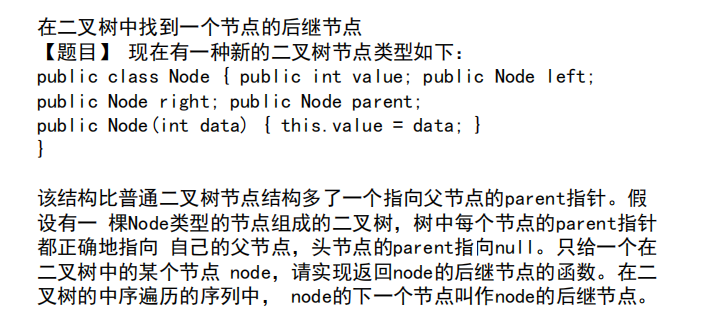
285.后继节点问题

1576680169342

1
2
3
4
5
6
7
8
9
10
11
12
13
14
15
16
17
18
19
20
21
22
23
24
25
26
27
/**
* 中序遍历:左根右
* 所以,假如该节点有右子树,那么后继节点是右子树的最左一个节点
* 假如该节点没有右子树,那么他一定是某一个节点p的左子树的最右节点,因此该节点后继节点就是p
* */
public TreeNode getSuccessorNode(TreeNode node){
if(node==null){
return null;
}
if(node.right!=null){
return getRightMostLeft(node.right);
}else{
TreeNode parent = node.parent;
while(parent!=null&&parent.left!=node){
node = node.parent;
parent = node.parent;
}
return parent;
}
}

public TreeNode getRightMostLeft(TreeNode node){
while(node.left!=null){
node = node.left;
}
return node;
}

297. 二叉树的序列化与反序列化

1
2
3
4
5
6
7
8
9
10
11
12
13
14
15
16
17
18
19
20
21
22
23
24
25
26
27
28
29
30
31
public String serialize(TreeNode root) {
if(root==null){
return "#!";
}
String res = root.val+"!";
res += serialize(root.left);
res+= serialize(root.right);
return res;
}

// Decodes your encoded data to tree.
public TreeNode deserialize(String data) {
String[] values = data.split("!");
Queue<String> queue = new LinkedList<>();
for(String s:values){
queue.add(s);
}
return recoverFromPre(queue);
}

public TreeNode recoverFromPre(Queue<String> queue){
String value = queue.poll();
if(value.equals("#")){
return null;
}else{
TreeNode root = new TreeNode(Integer.parseInt(value));
root.left = recoverFromPre(queue);
root.right = recoverFromPre(queue);
return root;
}
}

层次遍历

1
2
3
4
5
6
7
8
9
10
11
12
13
14
15
16
17
18
19
20
21
22
23
24
25
26
27
28
29
30
31
32
33
34
35
36
37
38
39
40
41
42
43
44
45
46
47
48
49
50
51
52
53
54
public String serialize(TreeNode root) {
if(root==null){
return "#!";
}
StringBuilder res= new StringBuilder(root.val+"!");
Queue<TreeNode> queue = new LinkedList<>();
queue.add(root);
while(queue.size()>0){
TreeNode node = queue.poll();
if(node.left!=null){
queue.add(node.left);
res.append(node.left.val+"!");
}else{
res.append("#!");
}
if(node.right!=null){
queue.add(node.right);
res.append(node.right.val+"!");
}else{
res.append("#!");
}
}
return res.toString();
}

// Decodes your encoded data to tree.
public TreeNode deserialize(String data) {
String[] values = data.split("!");
int index = 0;
if(values[0].equals("#")){
return null;
}
Queue<TreeNode> queue = new LinkedList<>();
TreeNode root = new TreeNode(Integer.parseInt(values[index++]));
queue.add(root);
while(queue.size()>0){
TreeNode node = queue.poll();
String s_left = values[index++];
String s_right = values[index++];
if(s_left.equals("#")){
node.left = null;
}else{
node.left = new TreeNode(Integer.parseInt(s_left));
queue.add(node.left);
}
if(s_right.equals("#")){
node.right = null;
}else{
node.right = new TreeNode(Integer.parseInt(s_right));
queue.add(node.right);
}
}
return root;
}

110. 平衡二叉树

1
2
3
4
5
6
7
8
9
10
11
12
13
14
15
16
17
18
19
public boolean isBalanced(TreeNode root) {
isBalance = true;
healperBalance(root);
return isBalance;
}

private boolean isBalance = true;
//返回树的高度
public int healperBalance(TreeNode root){
if(root==null){
return 0;
}
int left = healperBalance(root.left);
int right = healperBalance(root.right);
if(Math.abs(left-right)>1){
isBalance = false;
}
return Math.max(left,right)+1;
}

958. 完全二叉树

1
2
3
4
5
6
7
8
9
10
11
12
13
14
15
16
17
18
19
20
21
22
23
24
25
26
27
28
29
30
31
32
33
34
35
36
37
38
39
/**
* 层序遍历,设置一个停止标志,遇到空节点,停止标志为真,如果停止标志为真,再遍历遇到非空节点,则非完全二叉树。
* */
public boolean isCompleteTree(TreeNode root) {
if(root==null){
return true;
}
//当遇到第一个空节点时,将firstFull设置为true,假如是完全二叉树,后面所有节点都应该是空节点,不会再遇到非空节点
boolean firstNull = false;
Queue<TreeNode> queue = new LinkedList<>();
queue.add(root);
while(queue.size()>0) {
TreeNode node = queue.poll();
if (node.left != null) {
queue.add(node.left);
//假如firstNull==true,该非空节点前面有一个空节点,必定不是完全二叉树
if (firstNull) {
return false;
}
} else {
//第一个非空节点,记录标志
if (!firstNull) {
firstNull = true;
}
}
if (node.right != null) {
queue.add(node.right);
if (firstNull) {
return false;
}
} else {
if (!firstNull) {
firstNull = true;
}
}

}
return true;
}

222. 完全二叉树的节点个数?

1
2
3
4
5
6
7
8
9
10
11
12
13
14
15
16
17
18
19
20
21
22
23
24
25
26
27
28
29
30
31
32
/**
* 寻找root右子树的最左节点,假如该节点位于最后一层,那么root的左子树必定是满二叉树,可以计算出节点个数,对于右子树,继续递归
* 假如该节点位于倒数第二层,那么右子树是满二叉树,同理可计算
* */
private int height = 0;
public int countNodes(TreeNode root) {
if(root==null){
return 0;
}
height = getHeight(root,1);
return helpCount(root,1);
}
public int getHeight(TreeNode root,int level){
while(root!=null){
level++;
root = root.left;
}
return level-1;
}
public int helpCount(TreeNode root,int level){
if(level==height){
return 1;
}
//获取右子树最左节点的层数
int leftMostheight = getHeight(root.right,level+1);
//最左节点位于最后一层,左子树是满二叉树
if(leftMostheight==height){
return (1<<(height-level))+helpCount(root.right,level+1);
}else{
return (1<<(height-level-1))+helpCount(root.left,level+1);
}
}
  • 不判断root==null
  • ||以及&&的问题